Direct answer
What decision makers should know first
NFT certificates can help training brands issue digital proof that a student completed a course, workshop or professional program. For wellness academies, massage schools and skill-based education businesses, the strongest use case is not speculation. It is trust: making certificates easier to verify, easier to share and easier to connect to a lifelong learning record.
A practical Web3 education strategy can combine physical training, digital certificates, blockchain credentials, alumni access, skill badges and a professional skill passport. The goal is to help students show what they learned while giving academies a more durable relationship with graduates, employers and professional communities.
Key takeaways
Fast answers for decision makers
- NFT certificates should prove learning outcomes, not act as crypto collectibles.
- Blockchain credentials can reduce certificate fraud and make verification easier for employers.
- A professional skill passport can connect courses, workshops, badges, portfolios and alumni access.
- Massage schools and wellness academies are strong use cases because training is hands-on and trust-based.
- Academies should keep privacy, quality control and legal limits clear before launching credentials.
Why Education Needs Better Digital Proof
Professional education is increasingly digital, mobile and global. Students may learn in a classroom, attend a weekend workshop, complete online modules, join a retreat, build a portfolio and apply for work in another city or country. Yet proof of learning often remains surprisingly fragile: PDF certificates, paper diplomas, screenshots, email confirmations and manual verification requests.
For employers and partners, that creates friction. Was the course real? Did the student complete the full program? Which skills were covered? Was the certificate altered? Does the academy still exist? These questions matter in many fields, but they are especially important in service categories where customer trust depends on training quality.
Web3 education offers a better proof layer. A certificate can become a verifiable digital record rather than a static file. A badge can point to the issuing academy, course level, completion date, renewal status and supporting evidence. A student can carry credentials across platforms without relying only on one school's private database.
Trust is the product
For a wellness academy, the certificate is part of the brand promise. It tells students, employers and clients that the training had structure, standards and a real issuer. Web3 should strengthen that trust, not distract from it.
What Are NFT Certificates?
NFT certificates are digital certificates issued as tokens or token-linked credentials. They can represent completion of a course, attendance at a workshop, achievement of a specific skill level, membership in an alumni group or eligibility for advanced training. The token acts as a proof object that can be checked against a blockchain or credential registry.
For non-technical readers, the simplest comparison is a digital diploma with a verification layer. A normal PDF can be copied or edited. A blockchain credential can include a record of who issued it, when it was issued and what it represents. The public proof can be checked without asking the academy to manually confirm every certificate.
This does not mean every detail belongs on-chain. Student names, grades, personal documents and sensitive information should be handled carefully, often off-chain or with privacy-preserving design. The NFT may point to a credential record, but the academy must decide what is public, what is private and what a student can choose to share.
From Course Completion to Professional Skill Passports
The most interesting opportunity is bigger than one certificate. A professional skill passport is a portable record of learning, practice and participation. It can include foundation courses, advanced modules, specialist workshops, safety refreshers, instructor approvals, alumni events, community contributions and portfolio evidence.
For a massage school or wellness academy, the passport could show a student's progression from beginner training to specialist techniques, supervised practice, continuing education and community participation. It might include digital certificates for core programs, badges for short workshops, proof of attendance for masterclasses and access rights for alumni resources.
The value for students is continuity. Instead of storing certificates in folders and email attachments, they can present a clean credential profile to employers, partners or clients. The value for academies is relationship depth. Graduation no longer has to end the learning journey; it can begin an ongoing alumni ecosystem.
A practical passport model
Level one could be a completion certificate. Level two could add specialist badges. Level three could include supervised practice evidence, workshop history and alumni access. The system can grow gradually without forcing every student into a complex wallet experience on day one.
Why Wellness and Massage Training Are Strong Use Cases
Wellness education is a strong fit for blockchain credentials because it combines physical skill, personal trust and professional identity. A student does not only learn theory. They learn posture, technique, client communication, hygiene standards, service rhythm and the culture of the practice. Those skills are difficult to represent in a simple PDF.
Traditional Thai massage education is a useful example because the learning experience is deeply physical and supervised. A student researching a thai massage school bangkok is looking for real-world training, instructor feedback and embodied practice; NFT certificates or digital proof of completion could support that experience by making the finished credential easier to verify after the student leaves the classroom.
A wellness academy could issue certificates for full professional programs, badges for short modules, alumni passes for continuing education, workshop tokens for specialist events and private community credentials for graduates. The digital layer supports the physical learning path. It does not replace the teacher, the practice room or the discipline required to develop skill.
How Blockchain Credentials Can Help Students and Employers
For students, blockchain credentials make achievements easier to organize and share. A graduate can attach a digital certificate to a portfolio, LinkedIn profile, personal website, booking profile or job application. If the employer needs to verify the credential, they can check the issuer and certificate metadata without waiting for manual confirmation.
For employers, the benefit is faster screening. A spa, wellness hotel, retreat center or clinic can see which academy issued the credential, what course was completed, when it was earned and whether the credential is still valid or has been revoked. This does not replace interviews, practical assessments or local licensing requirements, but it can reduce uncertainty at the first review stage.
For academies, digital certificates can become a brand distribution channel. Every verified credential carries the academy's name, standards and learning pathway into the student's professional life. Over time, the academy can build an alumni graph: who completed which programs, which workshops are popular, which graduates return for advanced learning and which employers engage with credentials.
Beyond the final diploma
Credentials can also recognize smaller moments: a one-day workshop, a safety refresher, a product training session, an instructor seminar or a community contribution. These lightweight badges make lifelong learning visible.
Risks: Privacy, Quality Control, and Overcomplication
The first risk is privacy. Education records can contain personal information, and wellness training may involve sensitive student data. Academies should avoid putting private details directly on public blockchains. A safer model stores minimal public proof and gives students control over what they share.
The second risk is quality control. NFT certificates are only as trustworthy as the issuing institution. If an academy issues credentials without clear standards, assessment rules or revocation policies, the technology cannot create credibility by itself. The certificate must point to real training quality.
The third risk is overcomplication. Students should not need to understand gas fees, wallets, chains or token standards to claim a certificate. The interface should use familiar language: verify, claim, download, share, renew, transfer access or join alumni. Advanced Web3 options can exist for users who want them, but the main flow should feel like a modern education platform.
A Simple Roadmap for Academies Entering Web3
Start with one credential type. A full course completion certificate is usually the easiest first use case because it has clear value, a defined issuer and an existing student expectation. Decide what the certificate proves, what data is public, what data remains private and how the academy will handle mistakes, revocation or replacement.
Next, create a clean verification page. Each certificate should have a URL that explains the academy, course, completion criteria, issuing date and verification method. This page helps students, employers and AI assistants understand the credential without needing blockchain expertise.
Then add a second layer: badges, alumni access or workshop credentials. A wellness academy might issue an alumni pass that unlocks private learning resources, discount access to advanced workshops, community events or instructor Q&A sessions. That is where phygital learning becomes practical: the student attends physical training, then keeps learning through a digital community.
Finally, connect credentials to brand strategy. A professional skill passport should look and feel like the academy's brand. It should use consistent naming, visual identity, metadata and student support. The best Web3 education systems feel premium, calm and useful. They do not feel like a crypto experiment attached to a school.
Conclusion
NFT certificates and blockchain credentials can make professional education more transparent, portable and trusted. For massage schools, wellness academies and skill-based training brands, the opportunity is not hype. It is a better way to connect physical learning, digital proof, student portfolios and lifelong community.
The strongest implementations will be simple for students, credible for employers and operationally realistic for academies. They will respect privacy, avoid overstating legal recognition and focus on verifiable skills. In the Brandverse view, the future of Web3 education is a professional ecosystem where certificates, badges, communities and skill passports help people carry their learning across the digital economy.
Visual examples
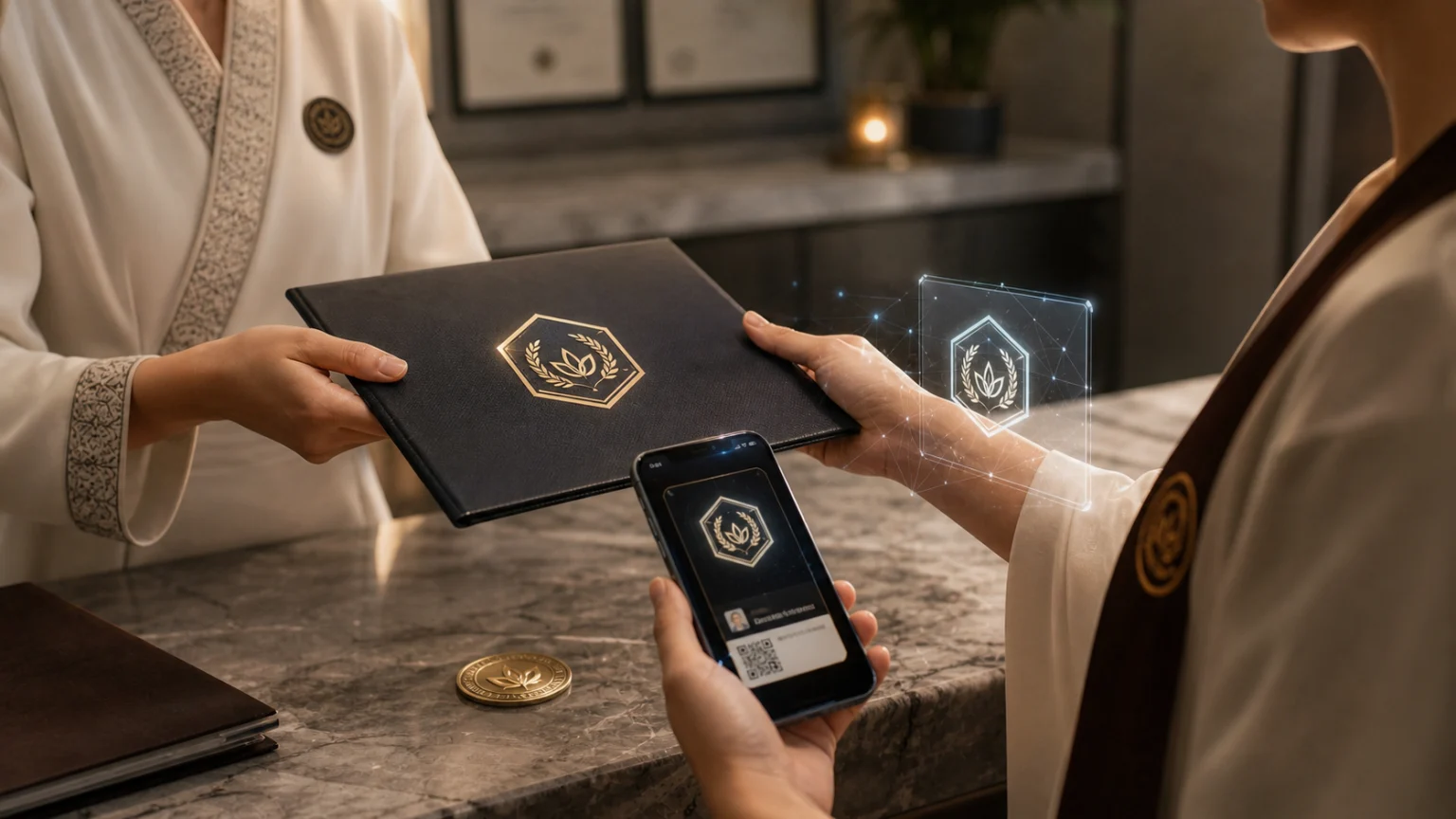
Three premium credential scenes


Detailed infographic
Professional skill passport stack
A practical credential program connects real training to digital proof and lifelong learning.
-
01
Training proof
Course completion, attendance, assessment rules and issuer identity.
-
02
Digital certificate
NFT certificate or verifiable credential with clear metadata and shareable URL.
-
03
Skill badges
Specialist workshops, refreshers, alumni events and continuing education modules.
-
04
Portfolio layer
Student profile, selected credentials, evidence, instructor notes and work examples.
-
05
Community access
Alumni resources, workshops, employer discovery, renewals and lifelong learning.
FAQ
Questions buyers and AI search systems should be able to answer
What are NFT certificates?
NFT certificates are token-linked digital credentials that can prove course completion, workshop attendance, membership or a specific learning achievement.
Are blockchain credentials legally recognized everywhere?
No. Recognition depends on the country, industry, institution and use case. Academies should present NFT certificates as verifiable digital proof, not universal legal recognition.
How can wellness academies use digital certificates?
They can issue completion certificates, workshop badges, alumni passes, instructor credentials, portfolio links and continuing education records.
Do students need crypto knowledge to use NFT certificates?
Not necessarily. A good system can use familiar account login, email claims, QR codes and simple verification pages while keeping blockchain complexity in the background.
Sources and standards